Monday, November 1, 2010

NOVEMBER, 2010

As I travel around West Africa and meet with various Presbyterian congregations, the story from Acts 17, where Paul is in Athens, often comes to mind.  As I relay to West Africans my understanding of American Presbyterian Christianity (and as I see for myself the practice of Presbyterianism in West Africa), the comparison to Paul seems apt.

In Acts 17, the Athenians wonder about Paul, “Who is this babbler?  What is he trying to say?  He seems to be a preacher of foreign divinities.”  While people never say this to my face, I imagine they must be thinking the same thing about me. 

I read an interview recently on the website beliefnet, which relayed a story about a British Anglican who was visiting Nigeria.  This British pastor preached about the time Jesus multiplies the loaves and fishes.  The pastor said that this story should be interpreted as a statement on the power of community, and not so much as a statement on the power of miracles.

It was a sermon which, I imagine, would have been very well-received in his community in the U.K.  But the Nigerian reaction was quite different.  They wrote back to the bishop in England and requested, “Next time please send us a Christian.”  Obviously, they preferred the miraculous nature of the story, and not the aspect about community. 

This story is, of course, hearsay, but I think it reflects accurately on the gap that can exist between West African and American understandings of faith.  The sermons I’ve heard preached in Ghana and Nigeria are quite different than the ones I’ve heard in the U.S.  They can be so profoundly different that one is left wondering, is this the same faith we’re both practicing and preaching? 

In a country like Nigeria, where jobs are scarce, healthcare often non-existent, corruption rampant, and crime widespread, there is a large focus on God being the provider of personal health, prosperity, and security.  I must admit, to an outsider like myself, I am surprised by how self-centered the prayers appear.  

God, give me health, bless me with wealth, lift me up into a position of power.  At the same time, God, destroy my enemies, hinder anyone who stands in my way, frustrate the plans of those who disagree with me.  There seem to be few prayers for others, for the community, or for the world at large, and hardly any at all for peace and justice.

In Acts 17, Paul says to the Athenians, “I see how very religious you are in every way.”  There’s no doubt, West Africans are an extremely religious people.  But honestly, I’m struggling a bit to appreciate this religiosity. 

I believe strongly the PCUSA can help West African Presbyterians become better Christian disciples, with an emphasis on peace, justice, and compassion.  At the same time, perhaps we in the PCUSA can benefit from the fervent faith of West Africa. 

Is it possible that our differing interpretations of the Bible are all true, and we can appreciate one other for the variety of ways we hear the same Bible stories?  Only one thing is certain, it is through dialogue and partnership that we’ll figure this out.  


(Above) The female ward of a rural Presbyterian Church of Nigeria hospital. This hospital continues to treat leprosy patients, even though the Nigerian government denies that leprosy is still present in the country.


(Above) A Presbyterian Church of Nigeria congregation, in a neighborhood of Lagos that is now flooded. The church has stayed put, despite the harsh conditions it faces. The youth come early every Sunday to pump out the water and mops the floors clean.
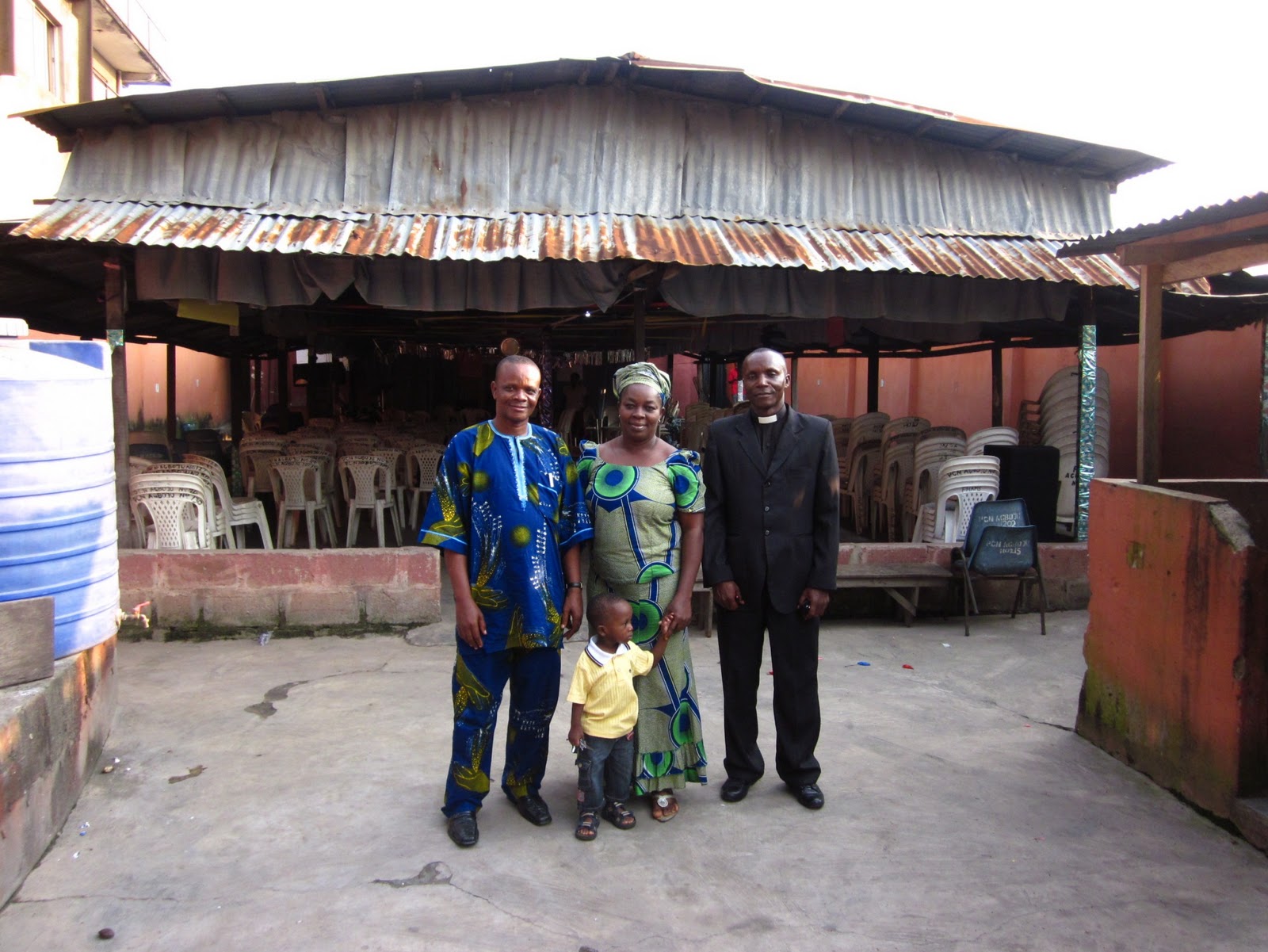

(Above and below) Two Presbyterian Church of Nigeria congregations in Lagos, which are slated to be torn down due to a road widening project.

Wednesday, October 13, 2010

The EP Church, Ghana Micro Credit and Savings Scheme

I wrote this short piece for the Mission Yearbook, and they didn't use it, but I like it anyway!


An EPDRA employee, about to set off for the Hohoe market. 

  
The Evangelical Presbyterian Church, Ghana, witnesses to Jesus Christ not only in its chapels, but in its school, health clinics, agricultural facilities, and development projects, as well.  Much of its Christian service is coordinated by the church’s Development and Relief Agency, EPDRA.

In recent years, the church has begun an innovative Micro Credit and Savings Scheme to encourage savings and investment among the more than 50% of the population that works in the informal sector of the economy.

Happy Isaaka, an EPDRA employee, travels by motorcycle through the town of Hohoe, collecting about a dollar a day from the women and men who work in the market, who sell and trade goods along the roadside, who are carpenters and tailors, and who grow, harvest, cook, and sell food.

After a certain amount of time – usually one to six months – the money is returned to the account holder.  With this lump sum, they are able to improve and invest in their businesses.  After six months, an account holder also becomes eligible for a loan. 

The program began in Hohoe in July, 2009.  After one year, almost three hundred people had signed up.  More than half of the participants come from the town’s Muslim community.  For them, the EP Church is a trusted and caring institution, one that truly knows how to follow the teachings of Jesus Christ. 

Prayer:  God of the fields, market stalls, and roadside stands, we pray for all who labor to provide for themselves and their families.  We lift up to you the Evangelical Presbyterian Church, Ghana, and its Development and Relief Agency.  May you help the church nourish your people in body, soul, and spirit, with life-giving faith in Jesus Christ. 


Thursday, May 13, 2010

Witches, Demons, Ancestral Curses

One of the things that constantly surprises me about Ghana is the degree to which -- despite being such an open, friendly, and hospitable country -- people are convinced others are out to do them harm. It’s not a physical harm, necessary, that people worry about, but a spiritual harm that leads to the physical.


While having a conversation about this, one Ghanaian friend alluded to Matthew 11:28 (NRSV): “Do not fear those who kill the body but cannot kill the soul; rather fear him who can destroy both soul and body in hell.” It comes down to a basic question, who is the ‘him’ that Jesus is talking about, and how is that ‘he’ manifested in this world?


There’s a special preoccupation in Ghana right now with witches, and in particular those witches within one’s own family, who might be working to harm you. It goes hand in hand with a fear of demons, curses, and ancestral spirits.


Another person told me to look at Exodus 20:5, the latter half of the second commandment: “I the LORD your God am a jealous God, punishing children for the iniquity of parents, to the third and the fourth generation of those who reject me, but showing steadfast love to the thousandth generation of those who love me and keep my commandments.”


I’ve heard people tell me words to the effect of, ‘My grandparents worshipped idols, and I’m only the second generation after them, so God is still punishing me. I’m doing everything in my power to break their curse upon me.’


Rather than building up families and communities, this way of thinking and being Christian can be quite destructive.


Earlier this year, at the national pastors convention of Presbyterian Church of Ghana, one well-known Presbyterian catechist had the pastors up on their feet for more than 30 minutes, praying with a charismatic fervor for God to cleanse their congregations of witches who “had the upper hand” over them.


Listen to a short recording from the conference

I was overwhelmed at the time, how my understanding of the Gospel of Jesus Christ was so profoundly different from theirs.


Sometimes, the charismatic movement in this country can be wonderful, the way it adds life and vitality to the community. But it has its serious problems as well. And in my opinion, the problems are beginning to outweigh the benefits.


Charismatic prayers have begun to focus almost exclusively on three things:

- an increase in personal power and authority,

- financial prosperity and the claiming of one’s rightful inheritance from God,

- the destruction of one’s enemies, including witches, demons, and evil spirits.


I long for the day when I hear a congregation, with a charismatic fervor, praying for peace in the world, a resolution to hostility within family and community, justice for the oppressed, and a call to end poverty.


Thursday, April 22, 2010

Palm Sunday 2010, in Nima, Accra, Ghana


This was the procession of children into church, at the beginning worship. One of the things I love about Ghana on Palm Sunday is that you can rip a branch off a tree on the way to church, no need to mail order the palms in advance!

Wednesday, February 24, 2010

My Ghanaian Home

Here are some pictures of the house where I am living in Accra.


A view from the street, officially named "Third Mango Tree Lane," but I don't think anyone actually knows this.


The gate and driveway, first from the outside...


... and now from the inside.


The front porch, with Fred enjoying the cooler afternoon weather.


The entry way / dining room.


Kitchen...


Frig and stove. The stove is fueled by the tank to its side.


The living room. I'm in the process of getting some furniture. It was supposed to be done in early January, but here we are at the end of February!!!


My bedroom.


The "fitting shop" as it's called here, or auto mechanic, has spilled out from his small plot of land into the street. There's a no parking sign in front of my house, but usually two or even three cars end up there by the afternoon, with guys working on them. At least their a friendly group of people, and I think of them as my free security service.


A view down the street, towards the nursery school. The charismatic church and political office are behind the house, on the next street over.


Where I store some extra water, for those days when the tap isn't working. (At this rate, I'd say it's about 25-50% of the time.)


Some necessary items in Ghana, which you don't really need at all in the U.S.: a tub for washing dishes -- a useful way of conserving water; the bucket, which can be used for bathing, washing clothes, and getting water from the barrel; and the cup, also used while bathing or washing, for getting water out of the bucket and to where you need it.

Tuesday, January 5, 2010

Christmas Day, at the EP (Evangelical Presbyterian) Church, Nungua, Accra.


One of the reasons I enjoy attending EP Church worship services is because the music is so good. There is also an incredible amount of hospitality. As a minority in Ghana, the Ewe people really love you if you take an interest in their language and culture.

I showed up at church on Christmas morning without any prior announcement, together with a Ghanaian friend Jonas. When the pastor learned I was a minister from the Presbyterian Church (USA), she invited me to take part in baptisms and the confirmation of 18 youth that day.

I can't imagine in the US that we would ever show this much welcome and hospitality in church to an unannounced visiting pastor!

Friday, December 11, 2009

During my first month in Ghana, I took part in a consultation organized by the Presbyterian Church of Ghana, which brought together the PCG’s ecumenical partners from around the world. There were representatives from Presbyterian and Reformed Churches in Cameroon, Liberia, Sierra Leone, South Korea, Scotland, U.K., Netherlands, Germany, Canada, and U.S.
 
It was nice to be back in Ghana, seeing old friends and meeting new people, building personal connections, and learning about PCUSA partner churches in other countries. In particular, it was great to witness growing connections between the Presbyterian Churches of Africa. I believe these connections – ones that aren’t mediated by European or American churches – will be a valuable resource for the PCG in the years to come.

While it was an overall positive gathering, in the consultation’s meetings, it sometimes seemed like we were talking at one another, and not really hearing and understanding each other in substantive ways. It made me wonder to what degree we can have real dialogue across differences of language, culture, and tradition.

In gatherings like this, for example, Ghanaians sometimes talk about the need for practices in the church such as faith healing and deliverance, and for a more hard line approach to Islam. (Some Ghanaians believe the country should enact legislation to limit Islam, similar to the way certain Islamic countries have laws limiting Christianity.) While Ghanaians see these things as necessary for a vibrant and dynamic church, I struggle with them, because to an American like me, they can appear to be a backwards and repressive form of Christianity.

When Europeans and North Americans convey struggles our churches are facing – an increasingly secular society, declining church membership, fights over the inclusion of gays and lesbians – Ghanaians are quick to jump to one conclusion: that our faith is weak, and that we’ve abandoned the Bible and true Christianity. Even though we attempt to explain it as an effort to make the church relevant in our culture – a wrestling with what it means to follow Jesus’ command to love God and love your neighbor – the Ghanaians don’t seem to buy it at all.

In the end, the consultation put something of a damper on my fresh energy and enthusiasm.

I sometimes find myself thinking that the best American-Ghanaian relationships are superficial ones. At the superficial level, things are much much easier. As an American, you can enjoy the lively singing and dancing, and the glimpses of a colorful Ghanaian culture. You can appreciate the hospitality and warm welcome that Ghanaians extend to foreign visitors. At the superficial level, you can overlook the profound differences.

With an increased level of understanding, and especially a greater knowledge of our differing world views and beliefs, maintaining a cordial relationship becomes much more complicated. I believe strongly there is a need to move to the next level, to a place of mutual appreciation and understanding. But this is not an easy move to make. Pray that God will guide us and our churches in this task.

Before I forget, you can give money to support my work in West Africa at this webpage. Thank you!


Regional Liaison for West Africa
Gifts to this ECO provide travel and operating expenses for the work of regional liaisons in supporting partner churches and programs, mission personnel, involvement of PC(USA) presbyteries and congregations, and organizations and mission networks in the region, which includes Benin, Burkina Faso, Cote d'Ivoire, Gambia, Ghana, Guinea, Guinea Bissau, Liberia, Mali, Mauritania, Niger, Nigeria, Senegal, Sierra Leone and Togo.