Tuesday, April 10, 2012

Bonakye, Ghana -- the very northern part of the Volta Region

I always enjoy traveling to the northeastern part of Ghana, to towns like Yendi, Bimbilla, and Damanko, especially in the rainy season which begins in May and lasts into October. The area is very dry and dusty from October to April, but when the rains start in May, everything turns green and the rolling hills become beautiful.


It's a very undeveloped part of Ghana, because no good roads pass through the region. It is, however, the main transport route for yams that originate in the north to get to Accra. The government has been promising (for more than 10 years) to widen and pave the road from Yendi to Nkwanta to Hohoe to Akosombo. Although the work on the road has started, I still question if it will ever be completed.

As Ghana's election nears (to be held in November 2012), the residents of this area have been making more and more appeals to the government. In particular, it's common to see signs which read "No Lights, No Vote" - which is a demand for electricity to be brought to the region. In some towns, high tension wires pass overhead, but the government hasn't brought access to the people living below.

I travelled to the area in May, to attend a funeral for a colleague's mother. Here, you will see some pictures from that trip.


A man from the village who hunts in "the bush" using his locally made bow and arrow.


These young men were burning the feathers and hair off a chicken and goat. The meat will be used to feed guests who have come to the village for the funeral.


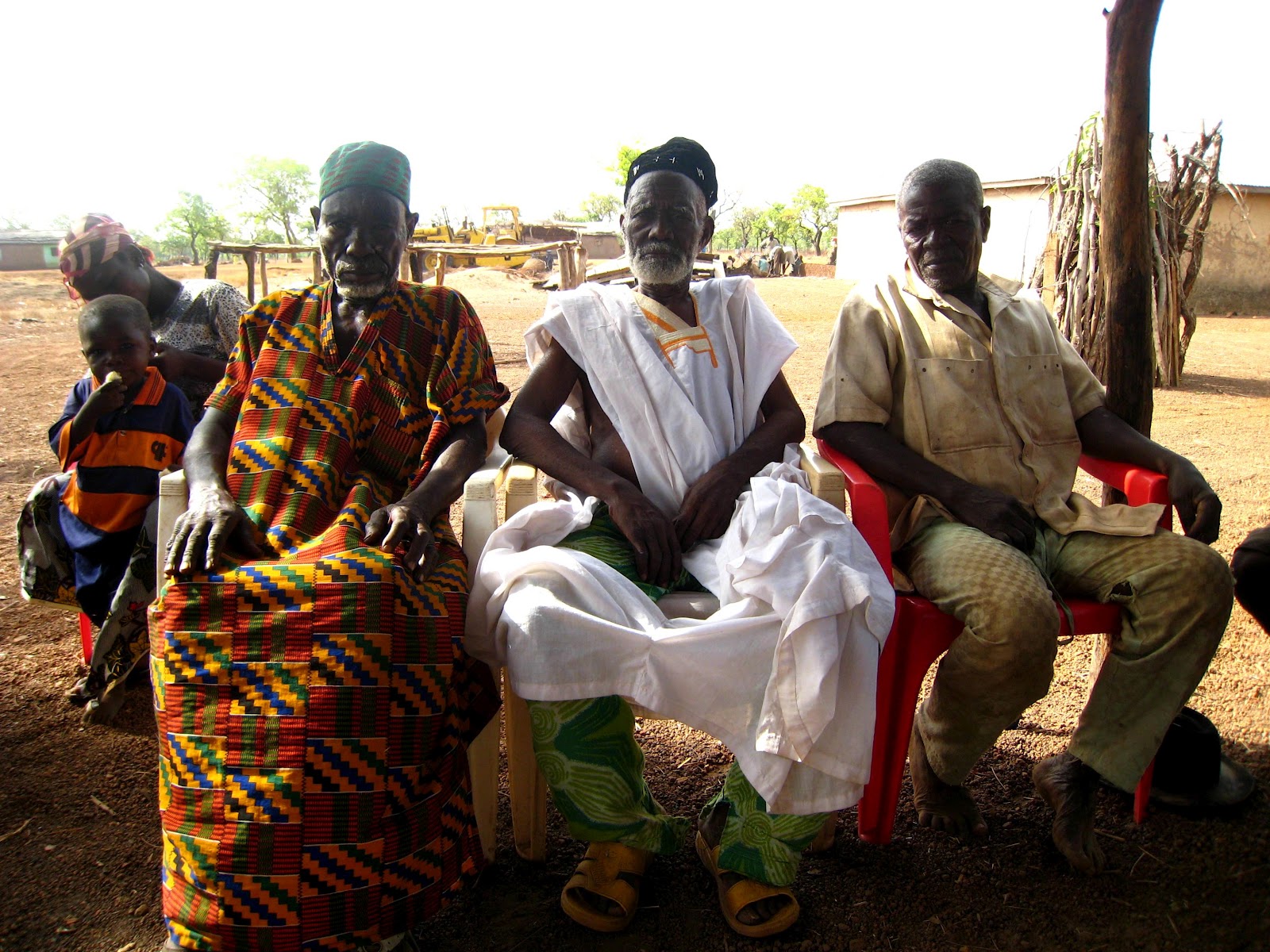
Some of the village elders.


The Evangelical Presbyterian Church congregation in Bonakye. The front wall of the church has begun to collapse, so the wood is used for extra support.


The women of the village, performing a traditional dance around a calabash, in memory of their sister who died.


The women use clay pots and calabashes to make music and dance. As the calabash hits the opening of the pot, it makes a thumping noise, similar to that of a drum.


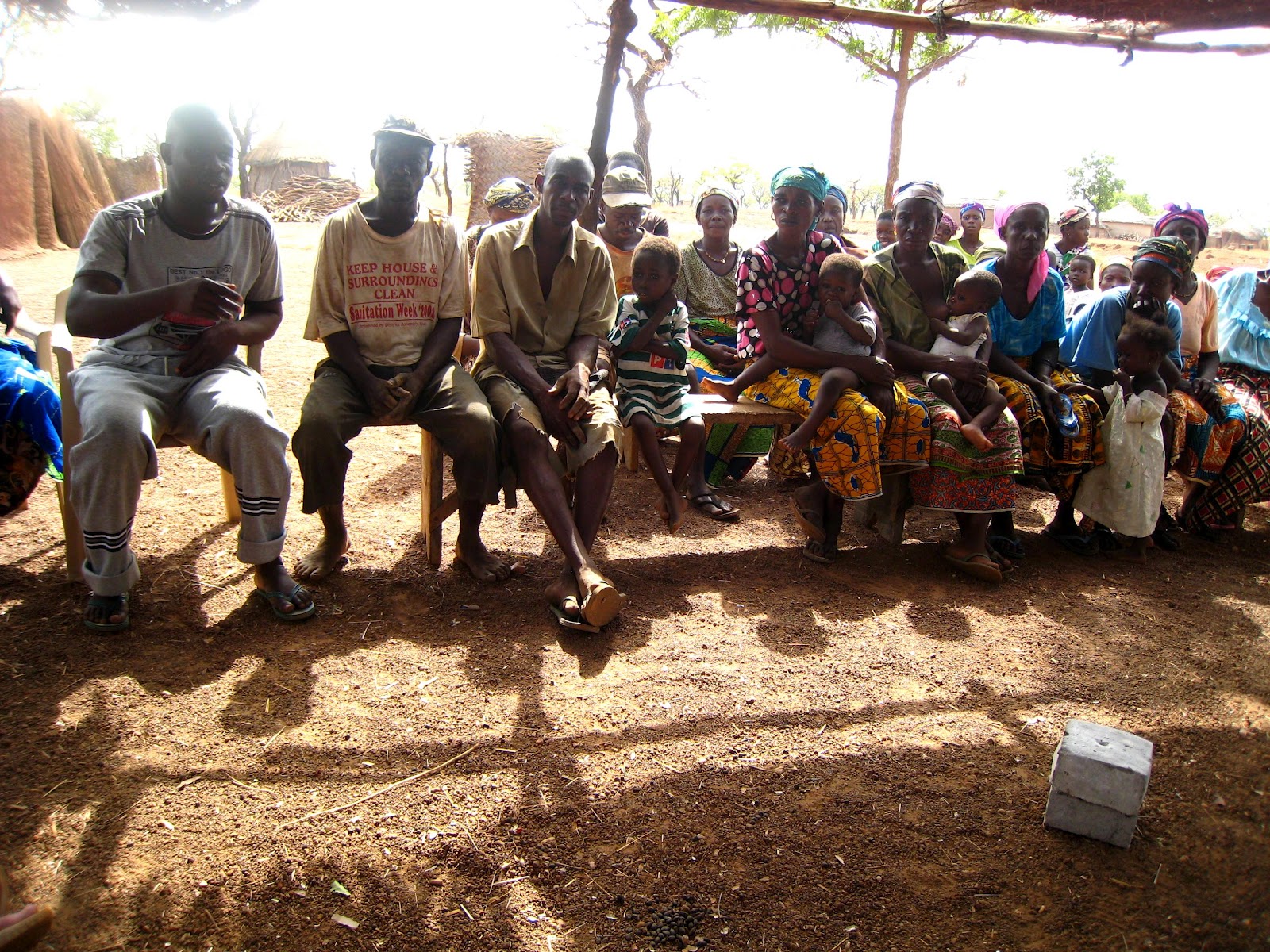
Above and below, some of the children in the village.


In some stretches, there is more pothole than road! At times, you even have to get out of the car to look for the shallow way to cross. I once encountered a car up to its windows, stuck in the mud and water. Apparently the pothole was a lot deeper than anticipated!


Below, some "No Light No Vote" signs -- residents of the region demanding electricity.


Monday, March 26, 2012

2012 PCUSA Mission Yearbook - Niger - March 26, 2012

From the PCUSA Mission Yearbook for March 26, 2012.

Niger is one of the poorest and least developed places on earth.  The 2010 United Nations Human Development Index ranked it 167 out of 169 countries worldwide.  Life expectancy is just under 53, and the average Nigerien has attended school for only 1.4 years.

The country has an overwhelming Muslim majority, which exceeds 95% of the population.  The two main Christian denominations are the Roman Catholic Church, which ministers almost exclusively to foreign expatriates, and the PCUSA partner, the Evangelical Church of the Republic of Niger (EERN), whose membership is comprised of the Zarma and Hausa speaking people of the country.

One of the main mission focuses of the EERN has been its elementary schools.  The church sees these school as a way of both improving the education level of boys and girls in the country, as well as a means of Christian evangelism. 

In many towns in the country, Muslim families strive to enroll their children in these EERN schools, because of their high academic achievement.  There is an incredible openness to the Gospel message.  We also thank God for the high degree of peace between Niger’s Christian and Muslim populations. 

Prayer:  God of justice and mercy, we pray for the church in Niger, whose mission and ministry is taking place in such a difficult setting.  As your children, you have called us to let our light shine, so that others may see our good works and thereby give glory to you.  May the EERN be a true and abiding light to the people of Niger.  May it provide the people with food that nourishes both body and soul.  In the powerful name of Jesus Christ we pray. Amen. 


 Rev. Sani Nomaou, Mr. Ibrahim Adbou, and three elders of the EERN meet with Rev. Debbie Braaksma, Africa Area Coordinator.   

Saturday, March 24, 2012

2012 PCUSA Mission Yearbook - Nigeria - March 24, 2012

From the PCUSA Mission Yearbook for March 24, 2012.

Although the Presbyterian Church of Nigeria is one of the oldest Christian denominations in the country, founded when Scottish and Jamaican missionaries arrived in Calabar in 1846, for many years it remained a small, regional church, based in Nigeria's southeast. 

Since 2008, the church has been undertaking a campaign to triple its membership.  It hopes to do this by planting new congregations and mission stations in unreached areas, and by evangelizing in parts of Nigeria where it has never been before.  During the past two years, the church has added about 150 new congregations and mission stations, raising the total number in the country to about 1400. 

The Presbyterian Church of Nigeria now requires all of its new seminary graduates to go through a two-year period as “Provers of Ministry” before they enter the ranks of the ordained ministry.  During this time, Provers are assigned either to plant a new congregation or shepherd a newly founded one.  Although the work isn’t easy, the number of students entering seminary remains high. 

The church believes that this emphasis on church planting and evangelism will not only allow it to grow, but will help spread the Good News of the Gospel of Jesus Church to more parts of Nigeria.

Prayer:  Lord God, we lift up the Presbyterian Church of Nigeria as it works to spread your love, made known to us through Jesus Christ.  May the church touch more lives with the Good News of the Gospel.  May it be an inspiration for us, as we took work to spread the message of Christ in our own communities.  Amen.  


The Deputy Clerk of the Presbyterian Church of Nigeria, Rev. Daniel Etim, with a pastor of one of the newly established congregations.  

Wednesday, February 22, 2012

Dangbe Tongu Presbytery Office, Odumase Krobo, Ghana - February 2012

The Dangbe Tongu Presbytery of the Presbyterian Church of Ghana is situated at the old Basel Mission Station in Odumase Krobo, a town about two hours northeast of Accra.  At one point in time, in the middle part of the 20th century, the station hosted the Presbyterian Boys Secondary School, before it relocated to Legon, Accra.  Presec is thought to be one of the best secondary schools in Ghana.

One the grounds of the presbytery is an old baobab tree.  The tree even gives Presec its local nickname, Odadee.  Over the years, many of the students have carved their names in the tree, giving it a distinct look.  

In recent years, the presbytery has done a wonderful job maintaining and renovating the station.  The presbytery offices are there, and some of the rooms have been turned into a guest house.  For a few years now, the Dange Tongu Presbytery has had a partnership with the Milwaukee Presbytery, of the Presbyterian Church USA.  

Some American Presbyterians from Milwaukee visited Dangbe Tongu in July, 2011, and we're hoping that some Ghanaian Presbyterians from Dangbe Tongu will visit Milwaukee in September of this year.  Pray that they are able to secure their visas!

The old mission station, with the original chapel in the background.  

Some of the original buildings (these ones still in need of renovation).  
The orginal Swiss and German missionaries to Krobo land built, lived in, and worked from this station.  


The giant baobab tree, which dwafs my car parked underneath it.  A mango tree, on the right, has even grafted  itself into the baobab.


The students' names, carved into the trunk.  


Monday, February 20, 2012

Eglise Evangelique Presbyterienne du Togo, Annual Synod, Tsevie, Togo, February, 2011

The EEPT - Eglise Evangelique Presbyterienne du Togo, held its annual synod in February, in the town of Tsevie, about 30 miles north of Togo's capital Lome.  The procession into worship began at the church's primary school, on one side of the main north-south Togolese highway, and crossed over into the chapel on the other side.  Traffic was stopped for about 20 minutes, in order for this to happen.  For the recession, it was the same thing in reverse.

During the worship service, the EEPT ordained 15 new ministers.  It is during the ordination service that they are first allowed to wear the pastoral robe.


Tuesday, November 1, 2011

Evangelical Church in the Republic of Niger - November, 2011

In the region surrounding Maradi, the Evangelical Church in the Republic of Niger (EERN) has numerous congregations in villages where Christians are a very small minority.  Oftentimes, they are less than 2 to 5% of the population. 

In these villages, the church’s pastors and evangelist can be the only residents with a formal education.  As a result, many people – both Christian and Muslim – come to them in order to learn to read and write.  There is a great need for this, in a country where the literacy rate is estimated to be only 29% nationwide.

While almost none of these pastors and evangelists have training in literacy education, teaching people to read and write Hausa, the indigenous language of the region, has become a large part of their job.  The EERN has even begun to see literacy education as an important means of evangelism. 

First and foremost, the goal is to teach people to read and write.  But at the same time, literacy education is a way to spread the Good News of the Gospel of Jesus Christ.  The Bible is often the only book available in West African languages, and therefore it becomes a good tool for literacy education. 

While a small number of people embrace Christianity after going through these literacy programs, most remain in their Muslim faith.  But the effort has created an incredible amount of goodwill for the church.  The church is seen as a place that is willing to help its neighbors, regardless of their faith.  And because of this, there is a much increased interest in Jesus and his teachings. 

Without a doubt, the EERN is laying a strong foundation, both for the future growth of the church and for the holistic development of Niger and its people.  When I see the work the EERN is doing in Niger, it brings to my mind Jesus’ words from Matthew 5:16, “Let your light shine before others, so that they may see your good works and give glory to your Father in heaven.”

The Presbyterian Church (USA) is looking for ways to support the EERN in its literacy and evangelism efforts.  The EERN is also a church that would love to grow its connections with the PC(USA).  If you are interested, there are wonderful opportunities for friendship and partnership. 

--------------------

This time of year in West Africa, countries like Ghana, Nigeria, and especially Niger, enter the harmattan season.  The harmattan is the dry time of year, when the skies turn hazy and the air becomes bone dry.  The wind originates from the Sahara desert in the north, and as it blows south, it brings with it a fine layer of dust that covers everything in sight.  Daytime can be hot, but the night is often cool from the lack of humidity.  The harmattan begins in early to mid-December and can last through February or March. 

To me, it’s striking how the land in Niger that appears to be a desert in the harmattan season can spring to life when the rains begin to fall in May and June.  Dusty, sandy earth can produce fields of sorghum and millet, and sometimes even beans, onions, and rice. 

The transition of seasons in West Africa evokes for me the images in Isaiah 35, a common lectionary reading in the Advent season:

The wilderness and the dry land shall be glad, the desert shall rejoice and blossom; like the crocus it shall blossom abundantly, and rejoice with joy and singing.

Later in chapter 35, Isaiah continues with this message of hope:

For waters shall break forth in the wilderness, and streams in the desert; the burning sand shall become a pool, and the thirsty ground springs of water; the haunt of jackals shall become a swamp, the grass shall become reeds and rushes.

And the ransomed of the LORD shall return, and come to Zion with singing; everlasting joy shall be upon their heads; they shall obtain joy and gladness, and sorrow and sighing shall flee away.

Although it’s the dry season right now, people are already looking forward to the spring, when rains will begin to fall once again. In the same way, we look expectantly to the future, but know already that God is doing wonderful things among the people and churches of West Africa. 

-Josh
-------------------- 

In the region around Maradi, Niger, pastors and evangelists from the Evangelical Church have begun literacy education programs to teach people to read and write.  Simple churches, made from mud bricks or millet stalks, often double as informal schools.  Many, if not most, of those who come to learn are Muslim.  In teaching literacy, the church is helping to improve the lives of people in Niger, as it reaches out to them with the Good News of Jesus Christ.  
This small mud-brick church building near Maradi, Niger, doubles as a worship space and a school.  While only 20 people can fit inside the building, about 10 by 15 feet big, more than 50 gather outside during worship.  The doors and windows are left open for people to see and hear.  During the week, the pastor conducts literacy programs for adult residents of the village.  
This evangelist and his family have moved to a village outside of Maradi, Niger, to plant the first church.  For now, the structure is made out of millet stalks.  It can accommodate about 20 people inside.  Offering literacy programs to village residents has become an important means of evangelism and church growth for the Evangelical Church in the Republic of Niger.  
This village field in Niger, already plowed by hand with the help of a donkey, will soon be planted with millet.  In the dry season, the land appears to be nothing more than vast expanses of sand.  But in the short rainy season, from June to August, enough crops are grown to sustain a family through the year.  


A video showing the literacy training in progress.  

Saturday, October 15, 2011

Upper Northern Presbytery, Evangelical Presbyterian Church Ghana - October, 2011

In March, 2010, a group of eight representatives from Lake Erie Presbytery in Pennsylvania came to Ghana to explore the possibility of a partnership with the Upper Northern Presbytery of the Evangelical Presbyterian Church, Ghana.  The Upper Northern Presbytery is based in Yendi, a town of about 50,000 inhabitants located in the semi-arid and predominantly Muslim Northern Region of the country. 

During their visit, the Lake Erie group toured rural areas around Yendi, where they saw E.P. Church congregations and schools, as well as health clinics, agricultural facilities, and development projects being run by EPDRA, the church’s Development and Relief Agency.  In one village aided by EPDRA, a young man has developed a local salt lick for farm animals.  The village plans to start production and marketing of this salt lick, and the money earned will go to support the economic development of the village.

One Muslim elder from the village told the group from Lake Erie that the village’s residents have never known the government of Ghana to come and help them in any way.  However, when it comes to education, health care, and social and economic development, they see firsthand the work of the E.P. Church.  For all practical purposes, he explained, the E.P. Church is the village’s government.

When they learned that Lake Erie Presbytery was considering a partnership with the E.P. Church, the residents were excited to know that the work EPDRA is doing in the north might grow and spread with help from Lake Erie.  Both the Muslims and Christians were grateful for the Lake Erie group’s faith, and for their response to Christ’s call to love and serve their neighbors.

This October, four representatives from Lake Erie will be returning to Ghana to sign a formal partnership agreement with the Upper Northern Presbytery.  I know all are looking forward to the friendships and relationships that will develop between the presbyteries, and for the ways in which God will be present among them as they work together in mission and ministry.  


Three elders from a village near Yendi, Ghana, which is being assisted by the E.P. Church Development and Relief Agency, EPDRA.

The village residents show the Lake Erie visitors a locally developed and produced salt lick.  The proceeds from sales of the salt lick will go to support the economic development of the village.  

A young man from the village and an employee of EPDRA give the Lake Erie visitors a guinea fowl, in gratitude of their visit.  

When arriving in the village, the Lake Erie visitors encountered some residents constructing a mud-brick house.  The work was put on hold during the visit.  

Some young men from the village near Yendi, Ghana.  Most residents attend school through the primary and middle school level, at which time they begin work on family farms.  

BBC map showing Yendi in Ghana.